
Time isn’t managed: it’s created. Here’s how to stop chasing your days
 Estimated time: 6 min
It’s 7 a.m. and your day is already over.
No, not in the sense that it’s really over.
In the sense that you already know how it will go: back-to-back meetings, emails piling up, urgent phone calls, the team that needs you, that strategic project you’ve been postponing for weeks because “you don’t have time.”
And in the evening, when you finally stop, that feeling you know so well: you’ve done a lot, but you haven’t done anything that truly mattered.
Sound familiar?
A few years ago, I worked with an extraordinary entrepreneur.
Digital sector, 70 employees, three offices (one abroad), steadily growing revenue.
On paper, total success.
But when I met him, he was literally exploding.
He worked 12 hours a day, weekends included.
He had money, clients, visibility.
But he no longer had time to think.
I don’t mean time for himself (that’s already a luxury).
I mean time to think about his own actions.
I asked him a very simple question:
“When was the last time you managed to stay in silence and think for at least 20 minutes?”
His look told me everything.
Here’s the point: chaos doesn’t come from outside.
It comes from within.
The problem isn’t that you have too many appointments.
The problem is that you’ve become an employee of your own company.
You chase time instead of creating it.
You react instead of deciding.
And this, if you’re honest with yourself, you know very well.
In this article I want to share with you what I taught that entrepreneur (and hundreds of other leaders).
Not productivity techniques. Not little tricks to “optimize” your day. But a complete paradigm shift about what it really means to manage time.
Actually, no. Because time isn’t managed.
Time is created.
What you’ll learn
- Why 90% of leaders (and probably you too) are always reactive and never strategic, and what prevents you from getting out of this trap
- The 3C method that turns daily chaos into a clear system: Categorize, Calculate, Correct
- How to distinguish between activities that create value and those that are just “busywork” (and why 40–50% of your calendar is probably red)
- The Ruthless Calendar exercise: how to understand in 10 minutes where you’re wasting your life
- Why cutting 20% of the “consumption” of your time will free you more than any time management technique
The truth you don’t want to hear: you’re an employee of yourself
Let’s do a quick experiment.
Think about last week. How many of the things you did had you decided, and how many were reactions to what was happening around you?
Emails arrive → you reply.
Sudden meeting → you attend.
Team problem → you solve it.
Client calls → you’re there.
You’re always reacting.
And don’t get me wrong: being responsive is important. The problem is when it becomes the only way you live. When your day is an endless sequence of responses to external stimuli, instead of conscious choices.

The 3C Method: the system that turns chaos into clarity
Time isn’t managed. You can’t stop it, multiply it, save it, or pause it. You can only decide where to position yourself.
And when you position yourself in the wrong place, even the perfect day becomes a trap.
The 3C method is this: Categorize, Calculate, Correct.
Three simple words that, if applied consistently, will completely transform your relationship with time.
First C: Categorize
Divide all your activity into three simple areas.
1. Creation
This is the time you dedicate to the creative act. Strategy. Decisions. Vision. High-value content.
If you don’t do this, you’ll simply be a train going downhill without brakes.
2. Control
Management. Numbers. Checks. Monitoring. Administration.
Do you know what the problem is? In 80% of entrepreneurial activities, control is practically nonexistent. Or superficial.
Yet control time is fundamental because it shows you the point of arrival and the starting point.
3. Consumption
Emails. Phone calls (important ones and less important ones). Meetings. Sharing. Work urgencies. Generic operations.
Everything that “consumes” your time without necessarily generating strategic value.
Now take a moment. Think about your last week.
How much time did you dedicate to creation? How much to control? And how much to consumption?
(Spoiler: you probably dedicated 90% to consumption. Like everyone.)
Second C: Calculate
Now that you’ve categorized, you need to do what is technically called a “time audit.”
Ask yourself these questions:
How much time do I want to spend in each category?
Define the time you want to dedicate to creation, control, consumption.
Where am I unbalanced?
If you spend too much time in control, you won’t have time for strategy.
If you spend too much time in strategy, you won’t have time to give concrete answers to your emails.
(Yes, someone delegates this to an assistant. But if the assistant gives wrong answers, it becomes an even bigger problem for you.)
How can I reduce the time dedicated to these categories?
A mentor of mine used to always say: “Filippo, less is more.”
Every time you spend too much time compared to the results, you’re not working. You’re chasing your results.
How can you group meetings together? How can you batch emails? How can you work on multiple strategic levels at the same time?
Attention: reducing time doesn’t mean going faster.
It means doing less and producing more. Being more incisive.
Which area am I neglecting?
This is the question that hurts the most.
Because if you don’t realize you’re neglecting a sector – strategy, financials, checks – sooner or later that activity will demand payment.
It will deteriorate. It won’t have what it needs. It will be left adrift.
And the cost? You’ll have to work in urgency. Fix what’s broken. Chase opportunities.
If you don’t dedicate time to developing strategies, in a society where everything moves fast, you’ll fall behind.
And if in your sector you are last? I don’t know what may happen, but your revenue will certainly drop. Problems will come. Someone will overtake you.
Third C: Correct
Now let’s move to action. Three immediate moves.
1. Cut 20% of your time consumption
Immediately.
Remove 20% of your time from useless meetings.
Tell me the truth: how many times do you attend completely useless meetings? How many times do you leave a meeting saying to yourself, “I wasted time”?
Cut 20% of the time you spend on long emails.
(Today there are tools like ChatGPT that can help you. Write your email quickly and have it refined clearly. You waste half the time.)
Avoid useless tasks. All those things you write down to do that have no real meaning for you.
Or learn to delegate, if possible.
2. Block one hour a day in your calendar just for creation
One hour. Just yours.
No meetings. No emails. No tasks.
One hour to think. To decide. To design.
3. Automate and delegate everything someone else can do for you
In 80% of cases, they can even do it better than you.
Delegate. And dedicate at least one hour a day to creation.
Remember: if you can’t free up space in your day, there will never be space for what truly matters.
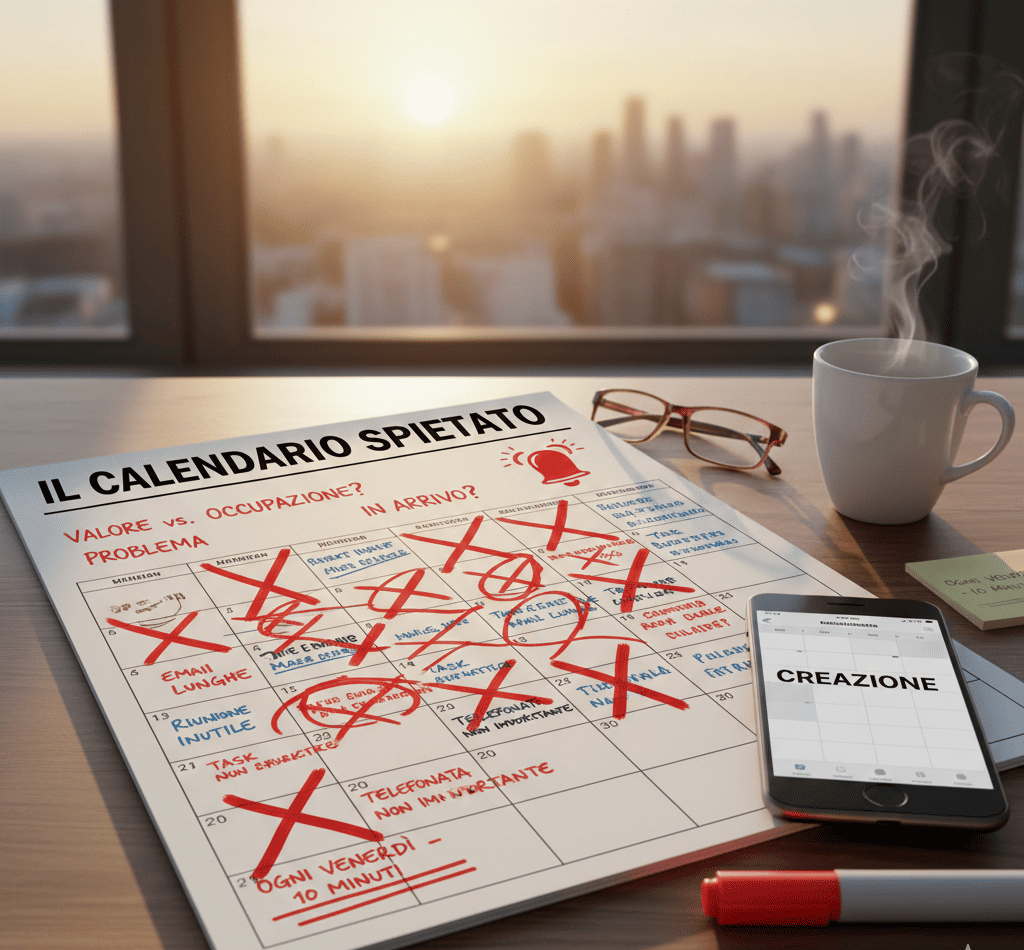
The Ruthless Calendar: the exercise that opens your eyes
I want you to do an exercise. Simple, quick, but ruthless.
STEP 1: Take last week’s calendar.
STEP 2: For each activity, ask yourself: “Did this activity create value for me, or just occupation?”
STEP 3: Mark in red everything you could have avoided, delegated, or concentrated.
You’ll see that your calendar will be red for at least 40–50%. And that red is an alarm bell telling you: “In your business, you’re about to have a problem.”
STEP 4: Repeat this exercise every Friday. 10 minutes, no more.
What no one tells you: the problem isn’t time
You can succeed beyond any limit. You can double your revenue, open new offices, hire employees, have clients looking for you.
But if inside you’re broken, that’s not success. It’s just the bill of a wrong system. The system inside you.
Time isn’t found. Time is created.
When you know who you are. When you know where you’re going. When you know what truly matters to you, to your team, to your life.
Where to start (tomorrow morning)
Tomorrow morning:
- Take your calendar
- Block one hour of your day
- That is your Creation hour
- Don’t book meetings there
- Don’t answer emails
- Just think, design, decide
Do it for a week. Then come and tell me what has changed.
Time isn’t managed. It’s created.
And creating it begins with a choice. Yours.