
The truth about multitasking that no successful leader will ever tell you
 Estimated time: 7 min
Have you ever bragged about being multitasking?
I know, it almost felt like a medal of honor.
“I’m always busy, I manage a thousand things at the same time, I’m always connected.”
And deep inside you there was that feeling of being super efficient, a person who knows how today’s fast world works.
Then one day you look at yourself in the mirror and realize that you’re just tired.
Tired, confused, with a list of open projects and very few actually completed.
With the feeling of running all day but never really getting anywhere.
And that question buzzing in your head: “Am I really making a difference?”
For years I’ve worked with CEOs, entrepreneurs, brilliant professionals.
Highly talented people who were hiding behind a single word: multitasking.
They thought they were being efficient. In reality, they were simply diluting their attention across a thousand things, achieving mediocre results in all of them.
Then I understood an uncomfortable truth: multitasking is not a shortcut to efficiency. It’s a shortcut to mediocrity.
In this article I want to share with you what I’ve learned working with high-performance leaders.
I won’t give you magic techniques or productivity hacks.
I’ll show you why everything you’ve been told about multitasking is wrong, and how to return to being truly focused, productive, and mentally clear.
What you will learn
In this article you will discover:
– Why multitasking is an illusion of movement that makes you look busy without actually moving you forward
– How to distinguish between being busy and being productive (spoiler: they are two completely different things)
– The “One Thing Only” method used by the most effective leaders to achieve extraordinary results
– Why every open project is a constant drain of mental energy and how to free yourself from it
– The 20/80 rule applied to your agenda to multiply results while reducing effort
Multitasking is a big lie (and you fell for it)
How many times has this happened to you?
You open an email. Then a WhatsApp notification pops up. You read it. Then you open an Excel file. A colleague walks in. You answer them. You go back to the computer. Then another notification. Another email. Another idea.
And at the end of the day, answer honestly: do you even remember why you turned on the computer?
That’s multitasking. It’s not efficiency. It’s organized confusion.
Multitasking makes you feel important, but it doesn’t move you forward.
It’s like taking many steps in the same spot. You move, yes. But you go nowhere.
The truth no one tells you
When you are present at 40% of your capacity in what you’re doing, your impact is zero. Zero.
The people who truly make a difference — those leaders you admire, those successful entrepreneurs you read about on Forbes — are not multitasking. Never.
They know how to do one very simple thing that you’ve forgotten: choose one thing at a time and bring it to completion fully.
It’s not sexy. It doesn’t make headlines. But it works.
(And they also sleep at night. You don’t.)

The story of the CEO who had become a weak Wi-Fi signal
Let me tell you about a CEO I worked with. Fashion industry, brilliant person, creative, visionary. But he had a huge problem.
He wanted to be everywhere. All the time.
I took his calendar and mapped out his weeks. Guess what I found?
– 18 meetings per week on average
– 11 projects open at the same time (very few fully completed)
– 6 work files always open on his computer at the same time
I looked him straight in the face and told him something he will never forget:
“My friend, you are not a leader. You are Wi-Fi. And not even good Wi-Fi.”
Silence.
Then I explained: “When you don’t complete your projects, when you don’t close your tasks, you are useful to no one. Not even to yourself.”
The rule of three
I gave him a very simple task:
1. Maximum three objectives per week
2. Only one project per day
3. No meetings in the morning (when the mind is clearer)
His first response? “Impossible.”
When you’re lost in your multitasking, anything that sounds like “less but better” feels impossible.
We reorganized his calendar. Three objectives per week. One project per day. Meetings moved to the afternoon.
Result after 15 days:
– Productivity increased by 100%
– Emergencies reduced by 40%
And an email that simply said: “I’ve finally started sleeping again. Thank you.”
The “One Thing Only” method: three steps to become effective again
Now I’ll give you the tools. Simple, concrete, replicable.
I call them “One Thing Only” — inspired by real principles of strategic productivity that I use with all my highest-performing clients.
1. The morning guiding question
Every morning, before anything else — in front of your coffee, your breakfast (which I hope is not just a croissant and cappuccino, but something that truly nourishes you) — ask yourself one simple question:
“If today I completed only one thing, which one would give me the greatest result?”
Just one thing.
Write it down. And do it first.
Because in the morning you are more alert, more operational, more creative. Your brain is at 100%. That will be the most productive activity of your day.
Don’t waste it answering emails or scrolling notifications.
2. The sacred block (60 minutes of deep focus)
Create a time block of at least 60 minutes in your day.
Rules of the sacred block:
– No notifications
– No calls
– “Do Not Disturb” mode on
– No multitasking
– One thing at a time
This is your sacred moment of impact. The moment when you will truly make a difference.
Not when you are available to everyone. But when you are available to yourself and to what truly matters.
(I know, it sounds radical. But try it for a week and then tell me.)
3. Eliminate to increase
This is the step that makes the real difference.
Go into your calendar of the last 15 days. Take your time, do it calmly.
Highlight all the actions you started and did not fully complete.
Then ask yourself for each one:
– Why did I start this action?
– What is it really for?
– Do I still need it?
– Do I close it definitively or eliminate it?
Every open project, every unfinished file, every half-done idea is a constant drain of mental energy.
It’s like having 60 apps open on your phone. The battery drains. And you don’t make it to the end of the day.
Free yourself from everything you will not complete. Decide where you truly want to make an impact.

The Pareto principle applied to your life (20% of actions = 80% of results)
Have you ever heard of the Pareto Principle?
It’s embarrassing how true it is: 20% of your actions generate 80% of your results.
Think about last week. How many actions were truly productive? And how many were just background noise, things that made you feel busy but didn’t move you forward even a millimeter?
The secret is not to do more. It’s to do less, but better.
Focus on that 20% of actions that generate real results. Eliminate the rest.
Less is more.
(A friend of mine, with extraordinary financial intelligence, for 50 years always jumped into multiple projects at the same time. Three years ago I convinced him: maximum three projects per week, but one at a time. He achieved the best financial results of his life.)
When evening comes, are you tired? You’ve wasted energy
Here’s the question you must ask yourself every evening.
When you get home, when you sit on the couch, when you switch off your brain after a day of work: are you tired?
If the answer is yes, ask yourself: for what?
Because when we do something and bring it to completion, that result nourishes us. Always.
We cannot be tired when we have completed something important.
But if you are tired, exhausted, if you reach the evening with the feeling that you ran all day without going anywhere, you’ve wasted energy.
You did multitasking. You jumped from one thing to another. You got lost.
Learn to think like a leader. Learn to decide like a successful entrepreneur. And learn to act like a guide — of yourself, first of all.
Stop doing everything. Start doing what matters
I want to give you one last piece of advice, maybe the most important.
Take off your medal of honor. The one you gave yourself because you are always busy, always available, always on a thousand fronts.
Stop thinking you are extraordinary because you do many things at the same time.
Multitasking does not make you a champion. It makes you ineffective.
In my offices — between Italy, Spain, England and soon also Greece — 20–25 collaborators work. But no one ever disturbs me. No one walks into my office randomly.
Because they know that when they knock on that door, it’s for an important reason. It’s because my answer at that moment will truly make a difference. There is no wasted time.
And I have specific moments when I am available to them. One collaborator at a time. Not in “I’m talking to you but thinking about five other things” mode.
100% present. 100% effective.
This is leadership. This is focus. This is respect — for yourself and for those who work with you.
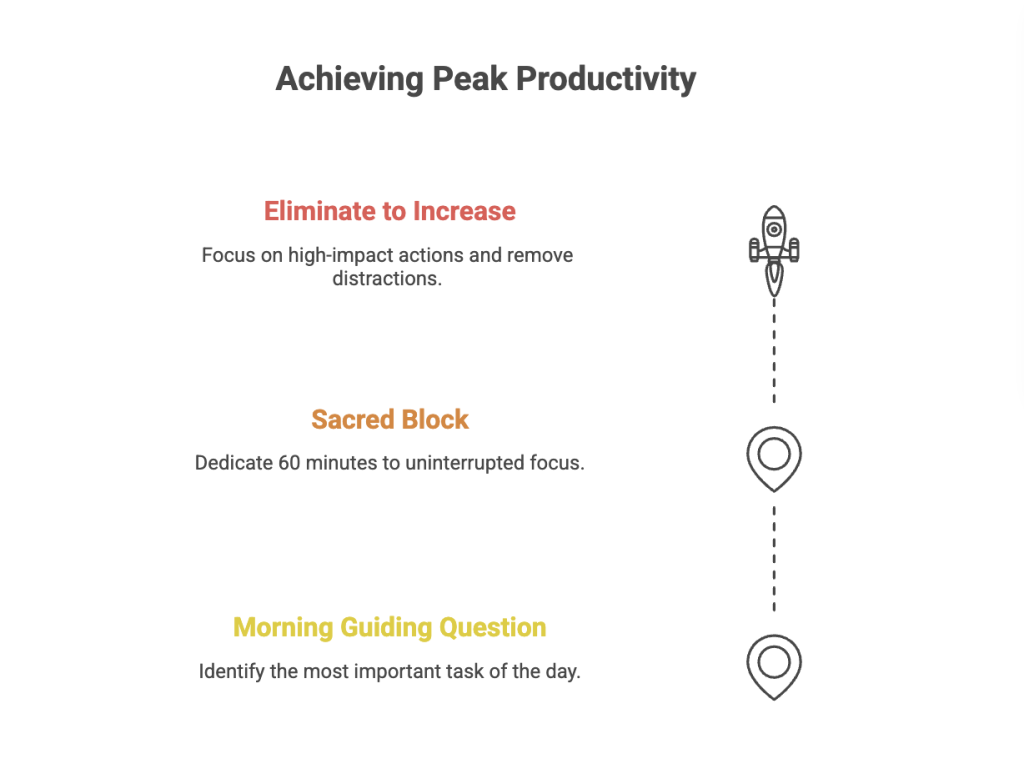
To recap: the three steps that change everything
- Morning guiding question
“If today I completed only one thing, which one would give me the greatest result?”
Write it down. Do it first. - Sacred block (60 minutes)
No notifications, no calls, no multitasking. One idea at a time. Sacred moment of impact. - Eliminate to increase
Focus on the 20% of actions that generate 80% of the results. Remove the rest.
It’s not me saying it. The best entrepreneurs in the world say it. It’s a law that everyone has experienced and verified.
Knowing how to do something doesn’t mean doing more. It means doing better.
Stop doing everything. Start doing what truly matters.
For you. For your collaborators. For your families. For your life.
Filippo Rossi